
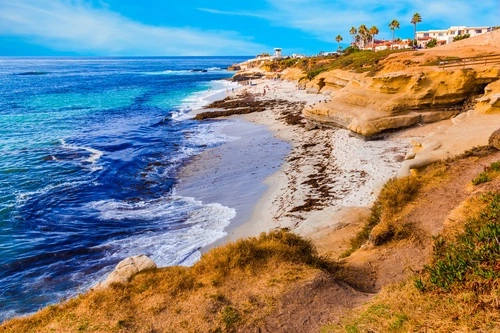
For years, sea-level rise and coastal erosion were often discussed as long-term planning issues. In parts of California, they are now immediate real estate and infrastructure problems. This week’s Los Angeles Times article, It’s time to rethink our relationship with the California coast, quotes the UCLA Coastal Flood Lab that “We’re likely going to break a number of water level records…. It’s not implausible to see some of the piers wiped out, or breakwaters or jetties.”
San Clemente is a good example. In September, severe waves and high tides forced another temporary closure of the coastal rail line after waves overtopped the tracks and damaged the adjacent slope. An emergency was declared and approximately 690,000 cubic yards of sand are being brought in to protect the rail corridor ahead of potentially severe El Niño conditions. That follows the recent completion of a $93 million project that includes a nearly 1,400-foot wall designed to protect the tracks from bluff failures. These local examples illustrate a much broader issue for California property owners, developers and public agencies: what happens when the coastline moves but the property lines do not?
Coastal erosion can affect far more than the obvious beachfront parcel. It can threaten roads, rail lines, utilities, public access, drainage systems and neighboring development. Efforts to protect that infrastructure—seawalls, revetments, sand replenishment, drainage improvements or even relocation—can create their own property-rights and land-use questions. For public agencies, the challenge is increasingly one of planning ahead. Caltrans recently updated its statewide sea-level-rise guidance to encourage transportation planners to evaluate exposure, assess climate hazards and develop adaptation strategies as part of project development. For owners and developers, coastal risk is also becoming part of ordinary real estate diligence. A property’s current condition may tell only part of the story. Future access, bluff stability, shoreline protection, permitting constraints and nearby public infrastructure can all affect how a coastal property can be used—and ultimately what it is worth.
And when sea-level rise, public infrastructure, and private property interact, difficult legal questions can follow. Aside from acquiring beachfront property through a concept called “managed retreat” (which would be expensive and potentially trigger condemnation), and relocating public infrastructure off the coast line (which can also require the use of eminent domain), a key question to be decided is who should bear responsibility for sea-level rise, and can public agencies face inverse condemnation or other property-rights claims if they do not allow protection devices or otherwise undertake efforts to protect private property but such efforts fail? The California Coastal Act has been around for 50 years, and the Coastal Commission faces an ongoing push and pull of how to allow development while also preserving beaches and access with rising sea levels.
Not every coastal loss creates government liability, of course. Waves, storms and natural erosion remain powerful forces, and causation matters enormously. But that is precisely why these issues should be evaluated before a crisis rather than after one. California’s changing coastline is no longer simply a climate issue. It is increasingly a real estate, infrastructure and property-rights issue—and one that agencies and property owners will be dealing with for years to come.

 Partner
Brad Kuhn is a California real estate lawyer whose practice focuses on complex real estate disputes, eminent domain, inverse condemnation, land use and major infrastructure and development projects. He represents public ...
Eminent Domain Report is a one-stop resource for everything new and noteworthy in eminent domain. We cover all aspects of eminent domain, including condemnation, inverse condemnation and regulatory takings. We also keep track of current cases, project announcements, budget issues, legislative reform efforts and report on all major eminent domain conferences and seminars in the United States.
Stay Connected
 RSS Feed
Categories
- Administration
- Appraisal
- Arizona
- California
- California
- CLIMATE CHANGE
- CONGRESS
- Construction
- Court Decisions
- Energy & Utilities
- Environmental Law
- EPA
- Events
- FAQs
- Goodwill
- GOVERNMENT ADMINISTRATION
- Inverse Condemnation & Regulatory Takings
- Land Use Planning
- Lawsuit
- Legal Developments
- Nevada
- New Legislation
- Policy Shifts
- Possession
- Projects
- Public Agency Law
- Public Agency Law
- Public Policy
- Publications
- Real Estate and Property Rights
- Redevelopment
- Regulatory Reform and Proposed Rules
- Right to Take
- Right-of-Way
- Risk Management
- Seminars
- Speaking Engagements and Presentations
- Texas
- trial
- Utility Regulation
- Valuation
- Videos
- Washington State
- Water
- Water Law
- Wildfire Management
